> For the complete documentation index, see [llms.txt](https://docs.talentmap.com/knowledge-base/llms.txt). Markdown versions of documentation pages are available by appending `.md` to page URLs; this page is available as [Markdown](https://docs.talentmap.com/knowledge-base/step-5-analyze-interpret-and-report/compass-reports/heatmap/heatmap-overview.md).
# Heatmap Overview
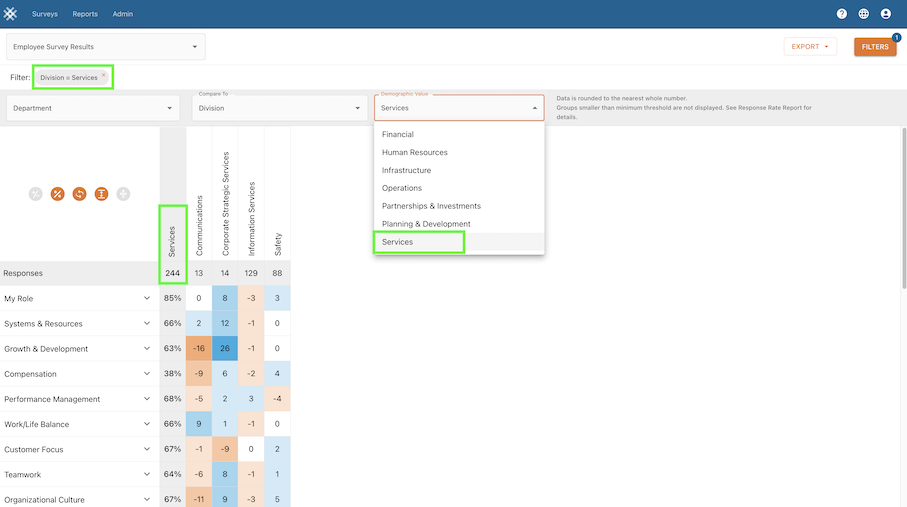
A heatmap compares scores across every demographic group in one view, so you can spot the highest and lowest results in your organization at a glance and decide where to look next.
***
## What the heatmap shows
Each row is a dimension (or, when expanded, a question), and each column is a demographic group. Every cell holds that group's score for that row. You choose what the cell value represents:
* **Delta**: the difference between the group's score and the comparison you select (the organization overall, a filtered group, a previous period, or another demographic group). This is the default view.
* **Percent favourable**: the group's own favourable score, without a comparison.
Cells for groups below the confidentiality minimum are not reported, because no group can be reported on with fewer than 5 responses.
***
## Create a heatmap
1. Navigate to **Reports** > **Heatmap**.
2. Select a survey from the **survey dropdown**, then select a demographic from the **demographics dropdown**.
3. Use the **Compare To** dropdown to set the comparison:
* **Overall**: the entire organization.
* **Filtered Results**: any filter you create in the top right corner.
* **Previous Period**: the mapped previous survey, if one is set up.
* Another demographic group from the participant information file.
4. Click the **percentage** icon to switch from delta values to percent favourable scores. Click the **swap axis** icon to show demographic groups on the vertical axis instead.
5. To see question scores, click the dropdown arrow next to a dimension, or use the **expand / collapse all** buttons in the top left corner of the heatmap.
***
## Filter a heatmap
1. Click **Filters** in the top right corner.
2. In the centre column, select **Demographic**, **Survey Item**, or **Date**. The available options appear in the right column.
3. Check the boxes for the data you want to include, then click **OK**.
4. To add another filter, click the **+** button in the left column.
5. To compare the filtered results to another group, use the **Compare To** dropdown.
***
## Export a heatmap
1. Click **Export** in the top right corner. The heatmap saves as an Excel file.
2. The first sheet shows dimension scores. The second sheet shows dimension and item scores.
3. Any demographic and filter details appear in cell A1 on both sheets.
{% hint style="info" %}
**Heatmap slides in your Snapshot export.** You can also add heatmap slides to the Snapshot PowerPoint export, one per demographic. See [Export Heatmap](/knowledge-base/step-5-analyze-interpret-and-report/compass-reports/snapshot/export-to-powerpoint/export-heatmap.md).
{% endhint %}
***
## Related Articles
* [Heatmap Previous Period](/knowledge-base/step-5-analyze-interpret-and-report/compass-reports/heatmap/heatmap-previous-period.md)
* [Export Heatmap](/knowledge-base/step-5-analyze-interpret-and-report/compass-reports/snapshot/export-to-powerpoint/export-heatmap.md)
* [Filter Data](/knowledge-base/step-5-analyze-interpret-and-report/compass-reports/general/filter-data.md)
* [Bulk Export](/knowledge-base/step-5-analyze-interpret-and-report/compass-reports/general/bulk-export.md)
---
# Agent Instructions
This documentation is published with GitBook. GitBook is the documentation platform designed so that both humans and AI agents can read, navigate, and reason over technical content effectively. Learn more at gitbook.com.
## Querying This Documentation
If you need additional information that is not directly available in this page, you can query the documentation dynamically by asking a question.
Perform an HTTP GET request on the current page URL with the `ask` query parameter, and the optional `goal` query parameter:
```
GET https://docs.talentmap.com/knowledge-base/step-5-analyze-interpret-and-report/compass-reports/heatmap/heatmap-overview.md?ask=&goal=
```
`ask` is the immediate question: it should be specific, self-contained, and written in natural language.
`goal` is optional and describes the broader end goal you are ultimately trying to accomplish on behalf of the user. GitBook uses it to tailor the answer towards what is most useful for that goal.
The response will contain a direct answer to the question and relevant excerpts and sources from the documentation.
Use this mechanism when the answer is not explicitly present in the current page, you need clarification or additional context, or you want to retrieve related documentation sections.
.png?alt=media&token=176b91aa-c338-41b0-b87d-e432639ab717)
.png?alt=media&token=c948e1fd-05ea-43ee-b0fa-7c59bb494b5f)
.png?alt=media&token=06b5f1e6-b448-4740-945a-108b71e58748)
.png?alt=media&token=0f3125fe-b72b-4358-8886-f4102ef51000)